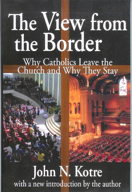
The View from the Border
Why Catholics Leave the Church and Why They Stay
Aldine Atherton Hardcover, 1971
Aldine Transaction Paperback, 2009
Preview through Google Books
Buy through Amazon.com
Buy eBook through Google
Why leave the church of your upbringing? Why remain in it despite deep differences? This is an empirical study of a hundred young adults who had intensive Catholic education. Fifty were still in the church; fifty had left. One finding: the Church that the "Ins" were in was not the Church that the "Outs" were out of. Despite a common exposure, Ins and Outs had vastly different perceptions of Catholicism. Here is an article that summarizes the findings.
"As a one-man job, this study is impressive. The book contains more news about the effect of Catholic education than anything written to date. The author writes with a personal flair."
-- M. Brewster Smith, Former President,
American Psychological Association
"The first broad-scale study of apostasy in any major religious group. The shock of self-recognition awaits all."
-- Nathaniel J. Pallone, New York University
"The first systematic and careful study of the phenomenon of religious apostasy from the psychological viewpoint. I recommend it."
-- Andrew M. Greeley, Priest, Sociologist, and Novelist
Part I: Prelude
1. Why the Border
2. One Hundred Young Adults: Who They Were and Where They Started
3. The Period of Change
Part II: The Results of Change
4. What They Believe
5. What They Value
6. The Two Churches
Part III: The Search for Why
7. Male versus Female
8. Parents
9. An Explanation
Part IV: Extensions
10. The Future of These One Hundred
11. The Institution as Permeable: Past, Present, and Future
Appendix I: A Note on Statistical Testing
Appendix II: The Questionnaire
Introduction to the 2009 Edition
The God wars are raging once again. A band of neo-atheists--Richard Dawkins, Daniel Dennett, Sam Harris, Christopher Hitchens, and others--are on a mission to end the "God delusion" once and for all. Back in the late 1960s, when I was doing the research for this book, "death-of-God" theologians were also trying to bury the Almighty. (Yes, they were theologians.) Harvey Cox had proclaimed--and celebrated--"the loosing of the world from religion and quasi-religious understandings of itself." Thomas Altizer and William Hamilton had been blunter: "We must realize that the death of God is an historical event, that God has died in our cosmos, in our history, in our existenz." To judge from the state of our existenz in 2008, God must have missed his obituary.
I've often wondered how data in The View from the Border would inform today's debate. Daniel Dennett might use the idiom of "breaking the spell" to describe the book's subject matter; that at least is the title of one of his books. He might applaud the fact that this was a scientific study, for science is how he wants to break religion's spell. But The View from the Border shows that breaking from religion, or remaining part of it, isn't about spells at all. It isn't about reason, science or "evidence." Rather, it's about the whole of a life, about trust and betrayal, about anger and joy, about loneliness and friendship, about awe and curiosity. It's about parents and lovers and children. It's about the intellect too, but something comes before intellect, some a-rational starting point, some pre-intellectual desire.
In 2008 the Pew Forum's U.S. Religious Landscape Survey reported that 28 percent of American adults had left the faith of their childhood--44 percent, if you included movement among Protestant denominations. The View from the Border addresses Catholic attrition, which was the greatest of all. The subjects of the book were a hundred young adults aged 21-31. By anyone's definition they were among the best and the brightest products of Catholic education. Fifty, by their own definition, were still in the church. Fifty were out. Their early exposure to Catholicism had been identical. Both Ins and Outs had attended Mass every Sunday, and about half of each group reported prolonged periods of attendance at weekday Masses. Most of each group experienced 16 full years of Catholic education. Most said that being a Catholic had been "one of the three most important things in my life." Yet in their twenties they went separate ways.
From April to December of 1968 I stood at the border, a 400-item questionnaire in hand, and observed them staying or leaving. This was a tumultuous period in American life. It began with the assassination of Martin Luther King, saw more and more opposition to the war in Vietnam, and ended with the election of Richard Nixon. Catholicism experienced a watershed event, the promulgation of Humanae Vitae, an encyclical banning the use of birth control. At the border, the church seemed to be an inkblot. When I asked, "Who is the Catholic church?" 60 percent of the Outs said it was the hierarchy or clergy; only 8 percent of the Ins did. To them the church was simply "the people." No matter how I asked the question, and I did many times in many ways, the contrast was immediate. One church here, another just across the line. And this despite identical--and intense--exposure to it.
The church that the Ins were in, in other words, was not the church that the Outs were out of. I am reminded of this at every skirmish in today's God wars. When neo-atheists use the word "religion," they evoke an image of fundamentalist Christianity that is inimical to science and "poisons everything." When theists use the word, they see a range of faiths mostly tolerant of science and even arising from same basic impulse. To them "religion" has flaws, but in the main it's a force for good. Here as well the contrast is stark: the religion the theists are in is not the religion the atheists are out of.
In my study of young adults, it became clear that positions on either side of the border were not reached on the basis of evidence, for the same evidence was acknowledged by both groups. Both mentioned unacceptable or irrelevant doctrines, racism among Catholics, the formalism and pomp of the hierarchy. The Outs, identifying these characteristics with the Catholic church, no longer wished to be a part of it. The Ins, considering the defects one aspect of the church, wished to remain members and even effect change. The "evidence," then, could be construed in a number of ways. Which way it was construed seemed more a question of wanting than a question of seeing. It had that a-rational starting-point.
And so I looked to beginnings. Ins, I found, were much more likely than Outs to have come from homes in which (1) both parents practiced Catholicism and (2) there were no gross disturbances such as divorce, separation, abandonment or alcoholism. These were "securely Catholic" homes, and in them a third factor was at work. Growing up, Ins felt closer than average to the parent of the same sex and Outs to the parent of the opposite sex. All three factors are the kind that lead to a deep internalization of parental values--in this case, the value of being Catholic. This value had little to do with reason, but it had a profound impact on reason later on. It had a profound effect on seeing.
Were corresponding factors at work in "securely atheistic" homes, I would expect a corresponding outcome--that children from these homes would maintain a secular worldview in adulthood, selecting evidence as Catholic Ins and Outs did. But that hypothesis awaits testing.
We should remember that the oldest person in my study was 31, and that the influence of parents may diminish over time. Unforeseen life events may take center stage. When Charles Darwin boarded the Beagle at the age of 22, he was a firm believer in Genesis and had in fact completed studies for the ministry. Later in life he became what most describe as an agnostic. He abandoned religion not because of any evidence he found on the Galapagos nor because religion was incompatible with his theory of evolution. Though he had given up a belief in creationism, Darwin left religion only when his beloved daughter Annie fell ill and died. He could not reconcile that loss with Christianity's claim that a good and loving God cares about every hair on our heads.
As director of the Human Genome Project, Francis Collins led a scientific journey comparable to Darwin's. Yet his religious journey was nearly the opposite. At age of 22 Collins was an atheist, the son of freethinkers. He entered medical school and a few years later began having bedside conversations with sick and dying patients. Many were deeply religious and, despite their terrible suffering, they were at peace "Suddenly all my arguments [for atheism] seemed very thin," Collins wrote in The Language of God. "I had the sensation that the ice under my feet was cracking.'' He began an intellectual search that led to C.S. Lewis and ultimately to Christianity, where his faith survived a trauma, though not a death, involving his daughter. This was a journey of reason, science, evidence and . . . bedside conversations. A whole life experience, a whole person making decisions about religion.
Biographies such as these are needed to complement studies like The View from the Border. In different ways, Charles Darwin and Francis Collins tell us what these Catholic Ins and Outs did, that catch-all metaphors like "spells" and "poison" are useless when describing religious experience on either side of a border. Only when we search for the ambiguities, the ironies and the paradoxes in the lives of both theists and atheists will we begin to comprehend the varieties of religious experience, as William James sought to do a century ago.
I would like to thank Irving Louis Horowitz, Transaction Publishers and Google Book Search for making The View from the Border available once again. They couldn't have picked a better moment. And when that moment passes, it is good to know that this and countless other books will be ready for whatever comes, just a click or two away. It's a whole new world.
Preview through Google Books
Buy through Amazon.com
Buy eBook through Google